Ringed longtail catshark
Ringed longtail catshark
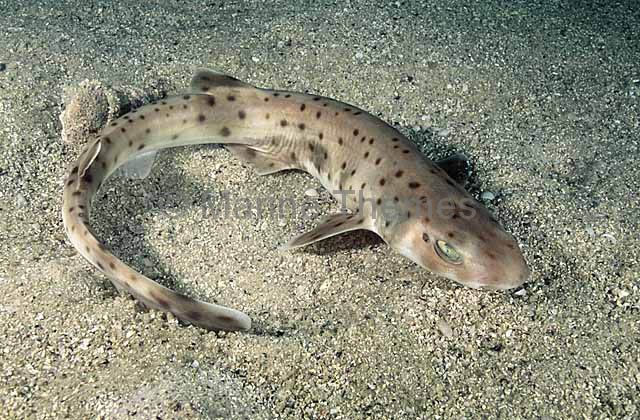
The ocellated long-tailed catshark is one of the sharks belonging to the Hemiscyllidae family . Its scientific name is Hemiscyllium ocellatum and it is from the order Orectolobiformes .
Where does the ringed longtail catshark live?
It is a shark native to the eastern Indian Ocean and the central western and southwestern Pacific Ocean. And it can be found in the waters of Indonesia, New Guinea and Australia , staying at depth ranges that go from 0 to 40 meters.
It should be noted that its presence is more common in shallow coastal waters, as well as in coral reefs located in the north of Western Australia and around New Guinea.
It is more active at night and at dawn, however, during the day it tends to be a little calmer, which is surely due to the light and the tides.
In the event that it is kept in captivity, it is necessary to provide them with a large pond or an aquarium that is open and wide. And that it also has a sandy bottom, since they are usually located in the lower part, and elements that simulate their natural habitat (algae, rocks, trunks, etc.).
Characteristics of the ringed longtail catshark
It is a small shark, because until now the maximum length that has been recorded is 1.07 meters; however, their average is 76 centimeters long and they do not usually exceed 900 grams in weight.
Without a doubt, the most striking feature of this fish are 2 large spots located on each side of the pectoral fins, which are black and bordered by a whitish circle.
On the other hand, he is shown as a rather restless and fast shark . And it is very agile in the water, which is due to its slim and streamlined body.
Another of the most outstanding characteristics is that it is attracted to delimited spaces, since they provide comfort and security.
Do ringed longtail catsharks eat people?
Fortunately these sharks do not show any interest in the consumption of human meat , and they are very small and calm.
Reproduction of ringed catshark sharks
They are oviparous, this means that the females lay eggs (1 pair every 14 days). Meanwhile, the hatching takes about 120 days in total and around 20 pups are born, which are between 14 and 16 centimeters long.
The period of sexual maturity occurs when the females are 60 to 62 centimeters long, while the males must wait until they are approximately 54 centimeters long. And the mating season is between July and November, although it changes when they are in captivity.
Is the ringed longtail catshark in danger of extinction?
Until now , it is included in the category of “ least concern” at a global level ; this according to the lists that were published in 2015, on the website of the International Union for Conservation of Nature.
However, it should be noted that in New Guinea it is almost threatened , which is mainly due to the contamination of its habitat and the destructive activities carried out on coral reefs.
However, in the waters of the remaining countries no major threats have been detected that could endanger the populations of the ringed long-tailed catshark.
Conservation of the Ringed Tailed Dogfish Shark
Although there are no specific measures to protect these sharks , there are areas that serve as a refuge , such is the case of the Ningaloo Marine Park and the Great Barrier Reef Marine Park, both located in Australia.
Curiosities of the Ringed Tailed Dogfish Shark
- Although it is a species of Least Concern globally, in New Guinea it is Near Threatened.
- It is very easy for him to camouflage himself.
- At first it takes time to grow, however, after passing the first trimester they begin to add 5 centimeters in length for each year.
- Captured for the aquarium trade, proving very popular for display.


Comments
Post a Comment